

3mm sintered stone is designed for projects where a thin, lightweight surface is more important than heavy structural thickness.
It can be useful for furniture, wall panels, decorative surfaces, cabinet applications and interior renovation projects.
However, 3mm material should not be selected simply because it is thinner.
Support structure, fabrication method, installation surface, cut-outs and final application all need to be considered before ordering.
This guide explains where 3mm sintered stone works well, where it may not be suitable, and seven important points project buyers should confirm before purchasing.
What Is 3mm Sintered Stone?
3mm sintered stone is an ultra-thin sintered surface manufactured for applications where lower weight and reduced overall thickness are useful.
Compared with thicker slabs, 3mm material is commonly considered for applications such as:
- wall cladding
- cabinet surfaces
- furniture panels
- decorative panels
- interior renovation
- lightweight surface applications
Because the material is thin, it normally relies more heavily on the supporting structure underneath.
This means the substrate and installation method are just as important as the stone itself.
1. Confirm the Final Application First
The first question should not be:
“Is 3mm cheaper?”
It should be:
“Is 3mm suitable for this application?”
3mm sintered stone is better suited to supported applications than heavy self-supporting structures.
Typical applications may include:
- furniture surfaces
- cabinet doors
- feature walls
- wall panels
- decorative cladding
- interior renovation surfaces
For applications that require significant structural strength or unsupported spans, a thicker material may be more appropriate.
The final specification should therefore be selected according to the project structure, not appearance alone.
2. Understand the Importance of the Substrate
Because 3mm sintered stone is very thin, the supporting substrate plays an important role in the final performance.
A stable substrate can help:
- distribute loads
- reduce flexing
- improve installation stability
- support the finished surface
- reduce unnecessary stress on the panel
Depending on the project, the substrate may be part of:
- furniture construction
- cabinetry
- wall systems
- composite panels
- interior decorative structures
Project buyers should confirm the supporting structure before production begins.
The stone should not be treated as an independent structural panel unless the complete system has been designed for that use.
3. Do Not Assume 3mm Can Be Fabricated Like 12mm or 20mm
One of the most important points is that fabrication requirements change with thickness.
A 3mm panel should not automatically be processed in the same way as a 12mm or 20mm slab.
For example, openings and complicated fabrication details require much more caution.
For our 3mm products, hole cutting is not recommended as a standard fabrication option.
If the project requires:
- sink openings
- cooktop openings
- large holes
- complex cut-outs
- heavy edge processing
a thicker slab may be a better solution.
Buyers should therefore send drawings before confirming 3mm material for complex fabricated components.
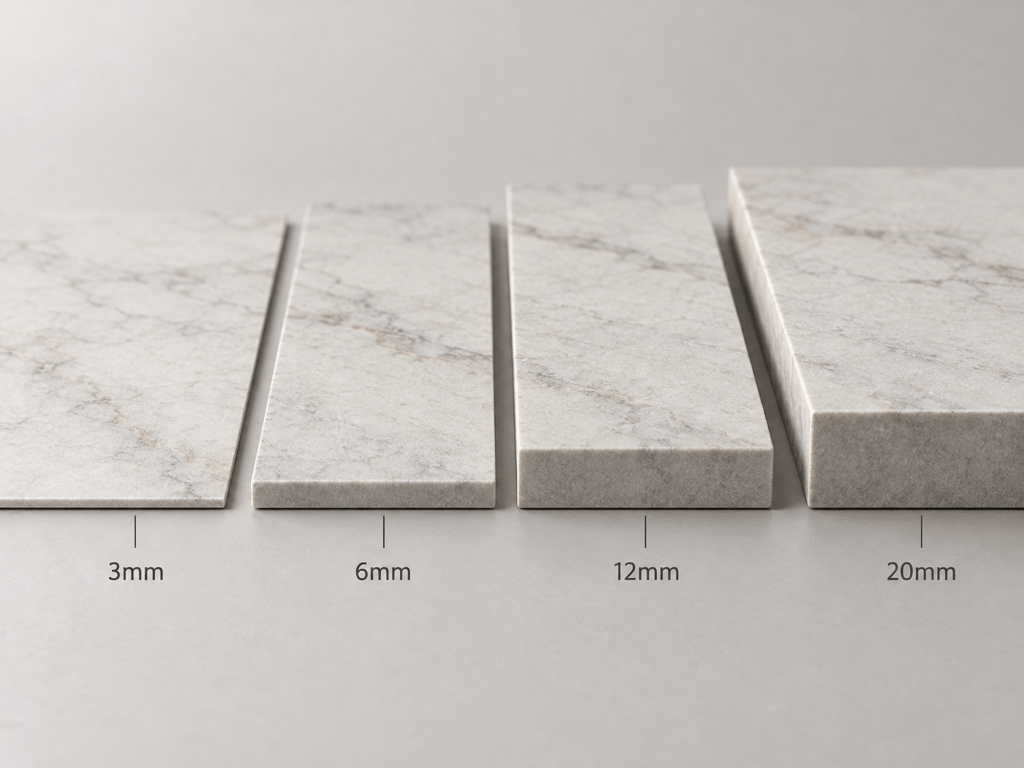
4. Compare 3mm With 6mm, 12mm and 20mm
Different thicknesses serve different purposes.
3mm
Best suited to lightweight supported applications such as:
- furniture surfaces
- decorative panels
- cabinet applications
- wall surfaces
6mm
May provide more flexibility for wall and panel applications where additional thickness is required.
12mm
Commonly used for many project fabrication applications, including countertops and cut-to-size pieces when the structure and design are suitable.
20mm
Often selected when buyers need a thicker slab, stronger visual mass or specific countertop applications.
There is no universally “best” thickness.
The correct choice depends on:
application + support + fabrication + installation
For a broader comparison, see our Sintered Stone Thickness Guide.
For general material testing and performance standards, buyers can also refer to ASTM International.
5. Confirm Panel Size Before Ordering
Panel dimensions affect:
- handling
- transportation
- installation
- substrate planning
- joint layout
- material utilization
Before requesting a quotation, project buyers should provide:
- required panel size
- finished size
- quantity
- application
- installation method
For wall or furniture projects, finished dimensions are especially useful because the supplier can evaluate whether the selected slab format is efficient for cutting.
If you are still estimating material usage, you can also review our guide on how to calculate sintered stone slab quantity for a project.
6. Consider Handling and Packing Requirements
Ultra-thin material requires careful handling.
Packing and transportation should be planned according to:
- panel dimensions
- quantity
- supporting structure
- edge condition
- stacking method
- export transportation
The objective is to minimize unnecessary flexing and movement during handling.
For international orders, buyers should confirm:
- package dimensions
- package quantity
- gross weight
- unloading method
- local handling conditions
A light panel is not automatically easy to transport if it is large and thin.
Proper support during movement remains important.
7. Confirm Installation Before Production
Installation requirements should be considered before the material is cut.
Buyers should clarify:
- substrate type
- installation surface
- adhesive or fixing system
- joint arrangement
- edge visibility
- panel orientation
- site conditions
For renovation projects, existing surfaces should also be checked for flatness and stability.
The final installation system should be suitable for both the substrate and the stone panel.
For commercial projects, coordination between the material supplier, fabricator and installer is especially important.
Where Is 3mm Sintered Stone Most Useful?
3mm sintered stone is particularly useful when a project needs:
- a thin surface
- reduced material weight
- modern large-format appearance
- decorative stone finish
- supported installation
- renovation-friendly surface solutions
It can be especially attractive for furniture manufacturers, interior contractors, designers and project buyers who need a stone-look surface without using a thick slab.
When Should Buyers Consider a Thicker Slab?
A thicker slab may be more suitable when the project requires:
- structural strength
- unsupported spans
- complex cut-outs
- heavy machining
- sink openings
- cooktop openings
- thicker finished edges
- countertop structures
In these cases, 12mm or 20mm may provide a more suitable fabrication solution depending on the design.
If the project requires precise cutting, edge processing or openings, see our Cut-to-Size Sintered Stone guide before finalizing the specification.
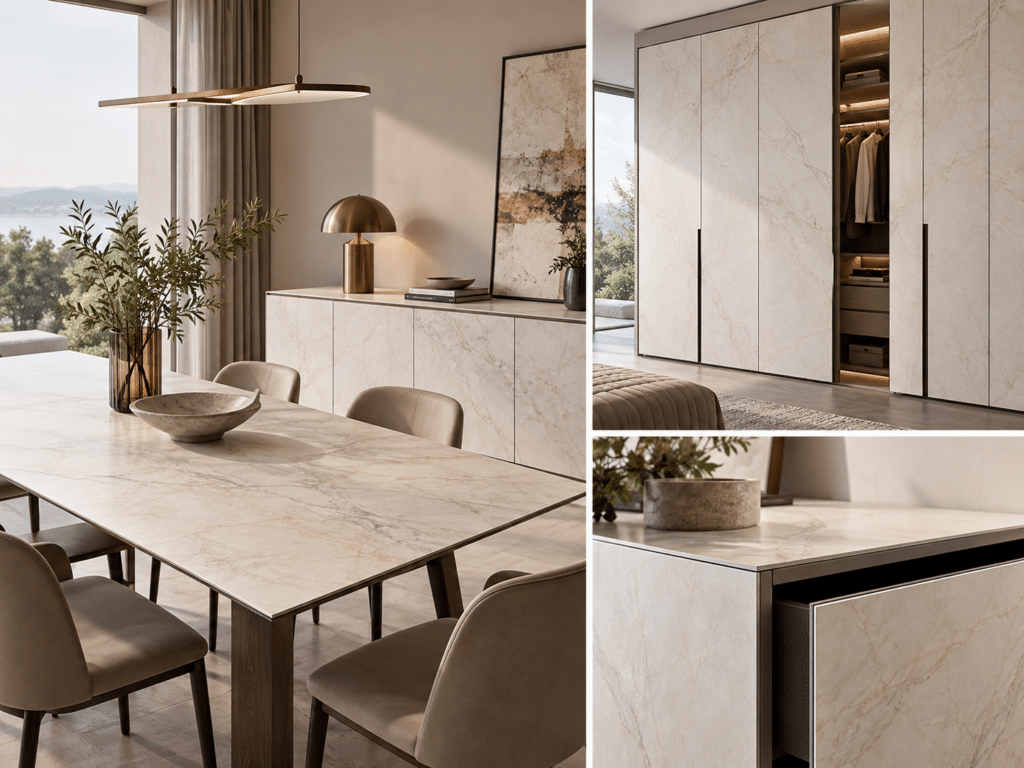
3mm Sintered Stone for Furniture Applications
Furniture is one of the most interesting applications for ultra-thin sintered stone.
Possible uses include:
- cabinet fronts
- table surfaces with structural backing
- side panels
- decorative furniture panels
- shelving surfaces
- customized interior furniture
The key is that the complete furniture structure provides adequate support.
Designers should evaluate the stone as part of the finished furniture system rather than as an independent structural component.
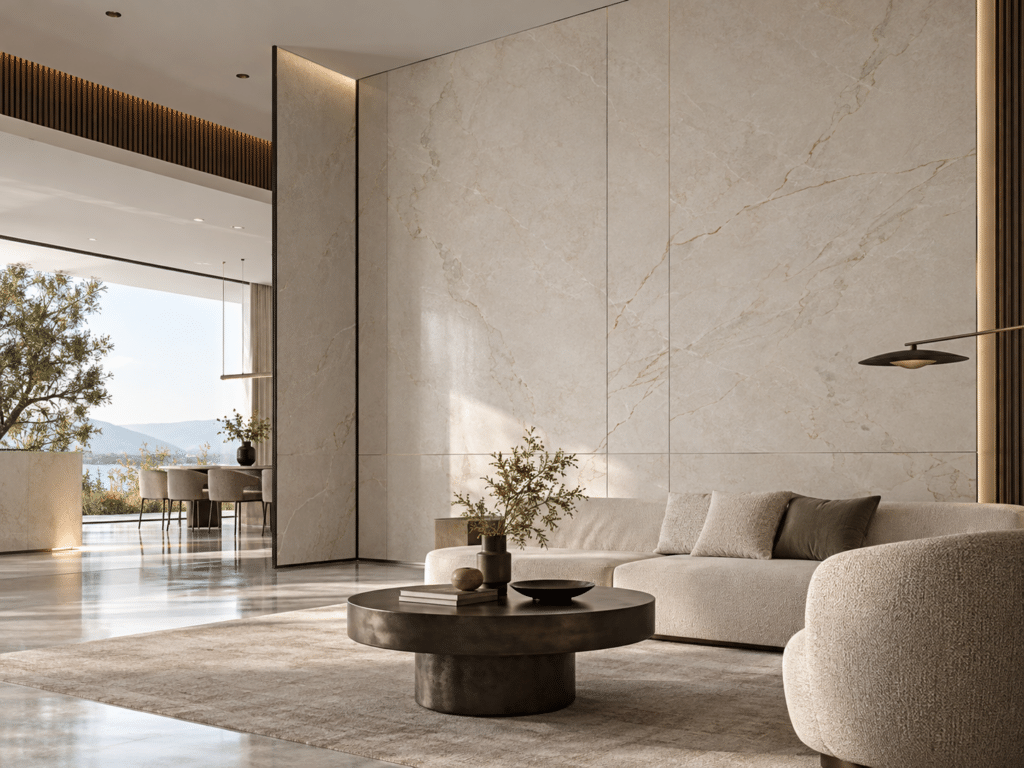
3mm Sintered Stone for Wall Panels
Wall applications are another important use.
Thin sintered stone can help create:
- feature walls
- lobby surfaces
- residential interiors
- retail interiors
- hotel wall applications
- decorative panels
Before installation, buyers should confirm:
- wall condition
- fixing method
- panel dimensions
- joint layout
- corner details
For large-format wall applications, installation planning should be completed before material preparation.
What Information Should Buyers Send for a 3mm Sintered Stone Quotation?
For a faster evaluation, send:
- Color or design
- Required size
- Quantity
- Application
- Finished dimensions
- Supporting structure
- Destination
- Drawing, if available
If you are unsure whether 3mm is suitable, send the application and drawing first.
The material thickness can then be evaluated according to the actual project requirement.
Frequently Asked Questions
What is 3mm sintered stone used for?
3mm sintered stone is commonly considered for supported applications such as furniture surfaces, wall panels, cabinet applications and decorative interior surfaces.
Can 3mm sintered stone be used for countertops?
It depends on the complete support system and project design. For conventional fabricated countertops involving openings or heavy processing, thicker slabs are usually more practical.
Can holes be cut in 3mm sintered stone?
For our 3mm products, hole cutting is not recommended as a standard fabrication option. Projects requiring openings should be reviewed before material selection.
Is 3mm sintered stone lighter than thicker slabs?
Yes, the thinner material reduces material weight, but large panels still require appropriate handling and support.
Does 3mm sintered stone need backing?
Supported applications generally depend more strongly on the substrate or backing structure than thicker slabs.
Is 3mm better than 12mm sintered stone?
Neither is automatically better. 3mm and 12mm are designed for different applications. The correct thickness depends on fabrication, support, installation and final use.
Can 3mm sintered stone be used for furniture?
Yes, furniture is an important potential application when the panel is properly supported by the furniture structure.
Looking for 3mm Sintered Stone?
If you are sourcing ultra-thin sintered stone for furniture, wall panels or interior projects, send us:
size + quantity + application + destination
If you have drawings, you can send them together with the inquiry.
We can help evaluate whether 3mm is suitable for the application and provide available designs and project information.

