A stone fabrication drawing is one of the most important documents in a custom countertop, vanity, furniture or commercial project.
It tells the fabricator what to cut, where to place openings, which edges are visible, how pieces connect and how the finished stone should fit during installation.
For project buyers, contractors and designers, checking the drawing before production can help reduce dimensional mistakes, avoid rework and make installation much smoother.
This guide explains seven important points to confirm before approving a stone fabrication drawing.

What Should a Stone Fabrication Drawing Include?
A useful stone fabrication drawing should normally show:
- finished dimensions
- material thickness
- piece quantity
- cut-out positions
- hole dimensions
- edge details
- corner radius
- joint positions
- visible sides
- pattern direction
- piece numbers
- drawing revision
For complex projects, the drawing should also clearly identify which dimensions are finished dimensions and which are only reference dimensions.
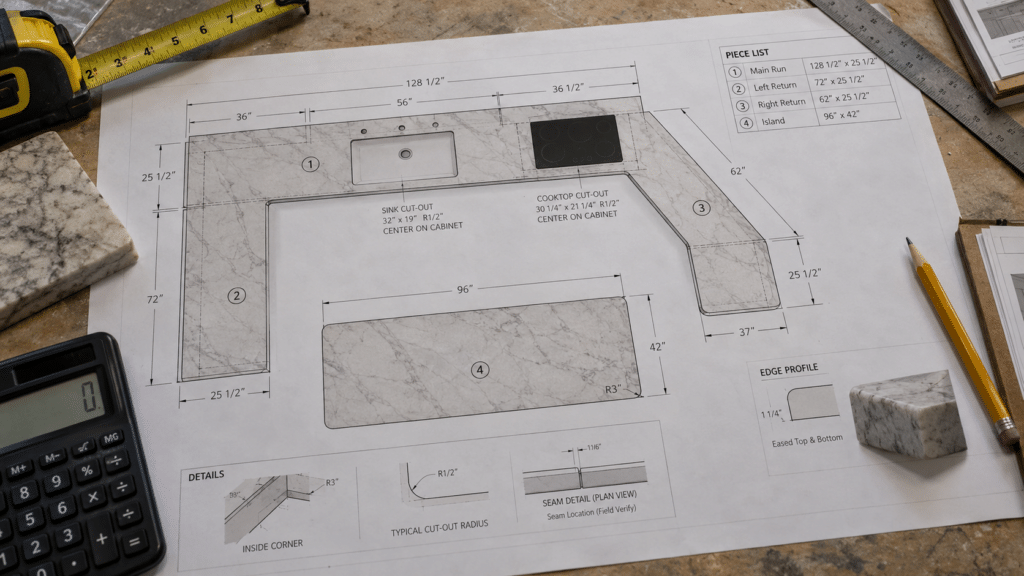
1. Confirm Finished Dimensions
The first thing to check is the finished size of each stone piece.
A clear stone fabrication drawing should show the finished dimensions of every piece before cutting begins.
Buyers should confirm:
- overall length
- overall width
- thickness
- finished edge dimensions
- installation allowances
- joint gaps
This is especially important for countertops, vanity tops and wall panels.
A slab size is not the same as a finished piece size.
The fabrication drawing should clearly show the final dimension required after cutting and finishing.
If several pieces are involved, each piece should be listed separately.
For larger projects, buyers can also review the expected slab consumption and cutting layout before production.
2. Check Cut-Out Positions and Sizes

Cut-outs are critical for kitchen and bathroom projects.
Typical cut-outs may include:
- sinks
- cooktops
- faucets
- sockets
- drains
- equipment openings
The drawing should show both the size and exact position of each opening.
For example, a sink cut-out should not only show the opening dimensions, but also the distance from the surrounding edges.
If equipment is already selected, the manufacturer’s technical drawing can also be used as a reference.
Do not rely only on visual proportions.
Exact dimensions should be confirmed before fabrication begins.
For projects that require formal material or testing standards, buyers can also refer to relevant ASTM International standards.
3. Confirm Edge Profiles and Visible Sides
Not every edge needs the same treatment.
The stone fabrication drawing should clearly identify every visible edge and the required finishing method.
The drawing should show which sides require:
- polished edges
- eased edges
- rounded edges
- mitered edges
- laminated edges
- unfinished edges
This matters because edge treatment affects both appearance and fabrication cost.
For countertops and vanity tops, buyers should clearly identify which edges remain visible after installation.
For waterfall islands or thick-look counters, the drawing should also show where mitered or laminated sections are required.
A simple arrow or edge code can help avoid confusion.
4. Check Corner Radius and Special Shapes
Many fabricated stone pieces are not perfectly rectangular.
Projects may require:
- rounded corners
- R3 / R5 / larger radius
- curved ends
- custom arcs
- angled cuts
- irregular shapes
The drawing should state the radius or geometry clearly.
For example, instead of writing only “rounded corner,” it is better to mark the exact radius.
If a special shape is difficult to describe, CAD drawings or templates may be required.
This is especially important for furniture, vanity tops and custom commercial projects.
5. Confirm Joint Positions
Large countertops or long pieces may need to be divided into multiple sections.
The drawing should clearly show:
- where joints are located
- how pieces meet
- which side overlaps
- whether the joint is visible
- whether pattern alignment is required
Joint planning can affect:
- transportation
- installation
- appearance
- structural support
For long counters, dividing the piece may be necessary because of slab size, transportation limits or installation conditions.
The joint position should therefore be approved before fabrication.
6. Confirm Pattern Direction
For materials with visible veining or movement, pattern direction should be marked on the drawing.
This is especially important for:
- waterfall islands
- reception desks
- wall panels
- vanity tops
- table tops
- connected countertop sections
Buyers should confirm whether they require:
- continuous vein direction
- coordinated adjacent pieces
- book-match effect
- random layout
- specific front-facing pattern
Not every slab can produce identical finished pieces.
For this reason, pattern expectations should be discussed before cutting.
For highly visible projects, slab photos or layout previews may also be used for confirmation.
For more details on project-specific fabrication, see our Cut-to-Size Sintered Stone guide.
7. Check Piece Numbers and Drawing Revision
For projects with many finished pieces, piece numbering is essential.
For multi-piece projects, the stone fabrication drawing should use consistent piece numbers across production and packing.
Each item should have a clear reference, such as:
- K01
- K02
- V01
- V02
- W01
- T01
The same piece number should appear consistently on:
- fabrication drawing
- cutting list
- packing list
- package label
This makes production, packing and installation much easier to track.
Buyers should also confirm the drawing revision.
If dimensions change during the project, the latest revision should replace the previous version.
Production should always follow the final approved drawing.

Why Drawing Approval Matters Before Production
Once stone is cut, many changes cannot be reversed.
A small error in dimensions, edge details or hole position may cause:
- installation problems
- wasted material
- re-fabrication
- project delays
- additional freight cost
For this reason, drawing approval should be treated as a production checkpoint.
The buyer and supplier should both confirm the same version before cutting starts.
What Should Buyers Send to the Fabricator?
For a custom stone project, buyers should ideally provide:
- Material or color
- Thickness
- Finished dimensions
- Quantity
- Application
- Drawing
- Edge requirements
- Cut-out details
- Pattern direction
- Installation notes
If the drawing is still preliminary, it should be clearly marked as not approved for production.
Frequently Asked Questions
Do I need a fabrication drawing for every stone project?
Not always. Simple rectangular pieces may only need a clear dimension list. Complex countertops, vanity tops, reception desks, furniture and wall panels should ideally have a fabrication drawing.
What is the difference between slab size and finished size?
Slab size refers to the raw material dimensions. Finished size refers to the final dimensions after cutting and fabrication.
How should sink cut-outs be shown?
The drawing should show the opening size, position and distance from surrounding edges.
Should visible edges be marked on the drawing?
Yes. Visible edges should be identified so the fabricator knows which sides require polishing or other finishing.
Why are piece numbers important?
Piece numbers help track production, packing, delivery and installation.
Can the drawing be changed after production starts?
Changes after cutting begins may cause additional cost or rework, so the final drawing should be approved before production.
Need Help Reviewing a Stone Fabrication Drawing?
If you are working on a countertop, vanity, furniture or commercial project, send us:
drawing + material + thickness + quantity + application
We can help review dimensions, edge details, cut-outs, pattern direction and packing requirements before production.
If you need help reviewing a stone fabrication drawing before production, send us the drawing and project requirements.