
When buyers compare sintered stone quotations, the lowest price per square meter is not always the lowest purchasing cost.
Two quotations may appear similar at first, but one may include export packing, fabrication and inland transport while another only includes the raw slab price.
To compare sintered stone quotations fairly, buyers should first make sure the material specifications and trade terms are the same.
For distributors, fabricators and project buyers, it is therefore important to compare quotations on the same basis.
This guide explains seven important cost checks buyers should make before selecting a sintered stone supplier.
For distributor purchasing considerations, see our Sintered Stone Slabs Wholesale guide.
What Should Buyers Compare in a Sintered Stone Quotation?
Before comparing prices, check whether each quotation includes the same items.
Important points include:
- material specification
- slab size
- thickness
- quantity
- fabrication
- packing
- inland transportation
- port charges
- ocean freight
- destination costs
- taxes and duties
A quotation that looks more expensive at first may actually include more services.
The first step is therefore to understand exactly what is included and excluded.
1. Confirm the Material Specification First
Price comparisons only make sense when the products are comparable.
Before comparing quotations, confirm:
- material type
- design or color
- slab size
- thickness
- finish
- quantity
- grade or quality level
For example, a 12 mm slab should not be directly compared with a 20 mm slab.
Likewise, a standard slab price should not be compared with a price that already includes cut-to-size fabrication.
If the specifications are different, the price difference may be reasonable.
For project orders, the final dimensions and fabrication requirements should also be confirmed before comparing total costs.
2. Understand Whether the Price Is EXW, FOB or CIF
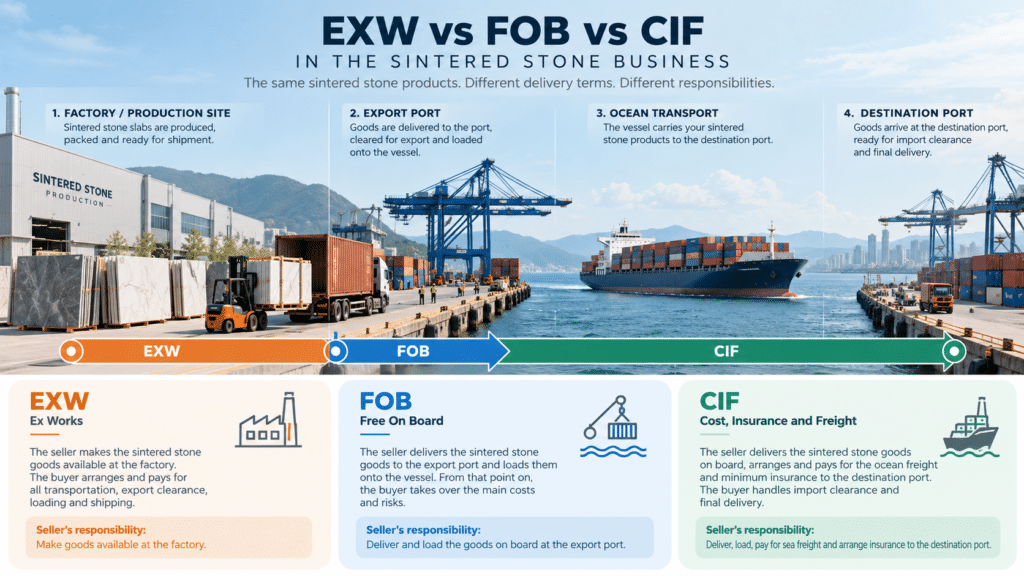
One of the most common reasons quotations look different is that they use different trade terms.
When you compare sintered stone quotations, always check whether the suppliers are using the same Incoterm.
EXW
An EXW quotation normally focuses on the goods at the supplier’s location.
The buyer may still need to arrange:
- pickup
- inland transportation
- export handling
- port delivery
- ocean freight
FOB
A FOB quotation generally includes more costs before the goods are loaded for export at the named port.
The buyer normally arranges the international freight from that point onward.
CIF
A CIF quotation generally includes the cost of goods, insurance and freight to the named destination port, subject to the agreed terms.
However, destination charges, customs clearance, duties and local transportation may still need to be paid by the buyer.
Because trade terms affect what is included, buyers should never compare EXW and CIF prices as if they were the same quotation.
For formal definitions and responsibilities, buyers should refer to the applicable ICC Incoterms® rules agreed in the contract.
3. Check Whether Fabrication Is Included
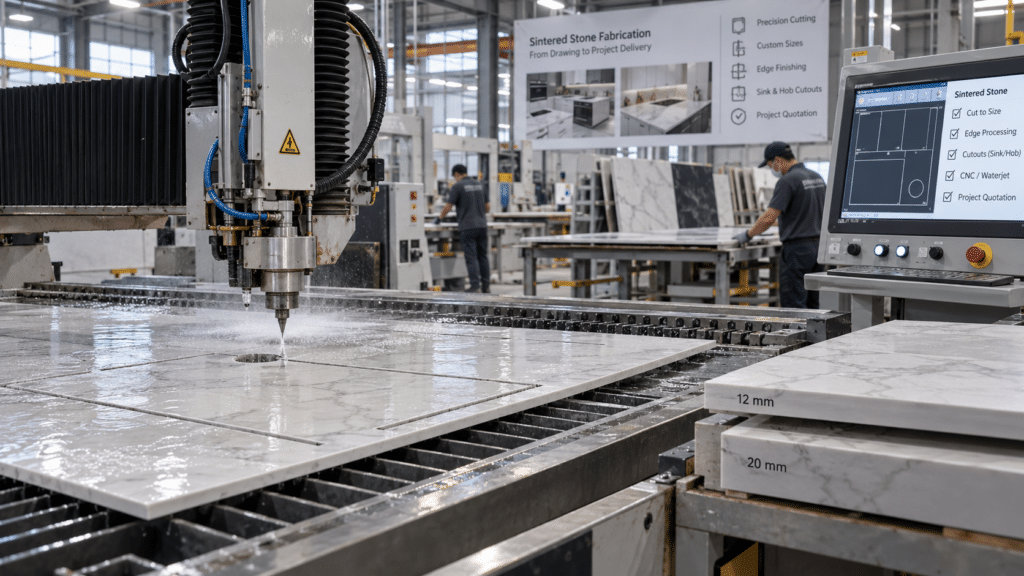
For project orders, fabrication can significantly affect the final quotation.
To compare sintered stone quotations accurately, fabrication costs should be reviewed together with the slab price.
Possible fabrication costs may include:
- cutting
- polished edges
- mitered edges
- laminated edges
- sink cut-outs
- cooktop cut-outs
- faucet holes
- socket openings
- rounded corners
- custom shapes
A supplier quoting full slabs may appear cheaper than a supplier quoting finished pieces.
But the buyer may then need to pay for fabrication locally.
This is why buyers should compare the total cost of the required finished product, not only the slab price.
For project-specific processing, you can also review our Cut-to-Size Sintered Stone guide.
4. Confirm Packing Costs
Export packing should be included in the cost comparison.
Depending on the order, packing may involve:
- wooden frames
- wooden crates
- foam protection
- edge protectors
- separators
- straps
- custom supports for fabricated pieces
Full slabs and finished countertops may require different packing methods.
A quotation that excludes packing may initially look cheaper, but the final shipment cost will increase once export packaging is added.
Buyers should therefore ask:
Is export packing included in the quoted price?
And if not:
How much does packing add to the total order?
5. Compare Freight on the Same Basis
Freight can vary significantly depending on:
- destination
- container type
- cargo weight
- shipment date
- port
- carrier
- local delivery requirements
For heavy stone products, container weight limits can be particularly important.
A container may have available space but already be close to the permitted weight.
Buyers should therefore compare:
- freight amount
- shipping route
- destination port
- estimated transit time
- validity period
- whether local delivery is included
If two suppliers quote freight differently, the buyer should confirm whether both quotations cover the same destination and service level.
6. Calculate the Landed Cost per Square Meter
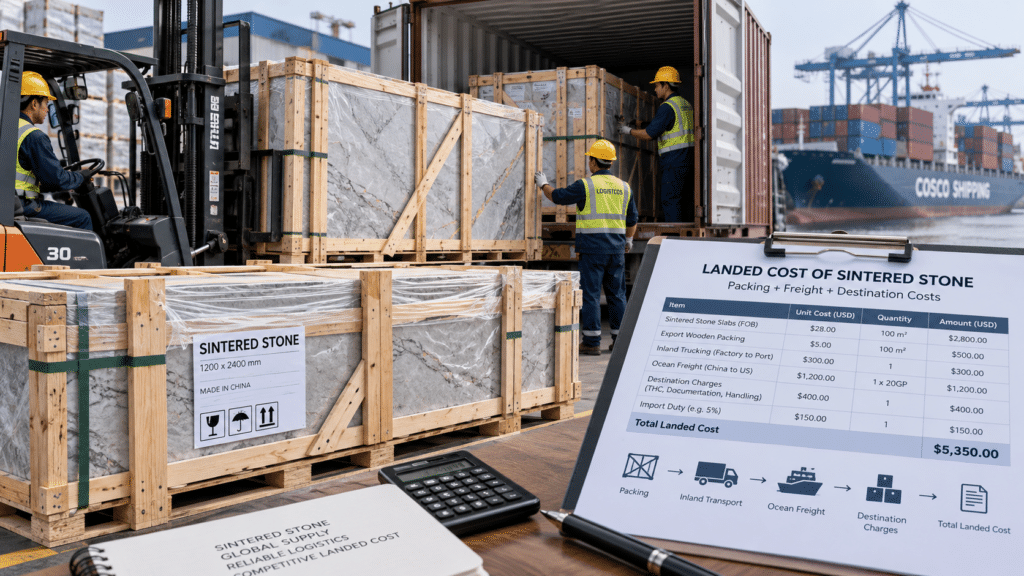
The most useful comparison is often not the factory price.
The best way to compare sintered stone quotations is to calculate the total landed cost rather than looking only at the factory price.
It is the landed cost.
A simple purchasing calculation may include:
Material cost
- Fabrication
- Packing
- Inland transport
- Ocean freight
- Destination charges
- Customs duty / tax
- Local delivery
Then divide the total by the usable quantity of material.
This gives a more realistic cost per square meter.
For example, a lower factory price may become less attractive if it requires expensive local fabrication or produces more material waste.
A slightly higher supplier price may still result in a lower final project cost if more fabrication is completed before shipment.
If you are still estimating the required material quantity, see our guide on how to calculate sintered stone slab quantity for a project.
7. Check What Happens If Specifications Change
Project quotations may change if the buyer later changes:
- thickness
- dimensions
- quantity
- edge treatment
- cut-outs
- packing
- destination
- shipping method
For this reason, buyers should confirm the quotation basis before placing an order.
A useful quotation should clearly identify:
- product
- specification
- quantity
- unit price
- fabrication
- packing
- trade term
- destination
- validity period
- production lead time
This reduces misunderstandings later.
EXW vs FOB vs CIF: Which Is Better for Stone Buyers?
There is no single best option.
EXW may suit buyers who:
- have their own freight forwarder
- manage export logistics regularly
- want more control over inland transport
FOB may suit buyers who:
- want the supplier to handle export delivery to port
- prefer arranging ocean freight themselves
CIF may suit buyers who:
- want the supplier to arrange freight to the destination port
- prefer a simpler initial shipping arrangement
The right option depends on the buyer’s logistics experience, destination and purchasing structure.
The important point is to compare quotations using the same trade term whenever possible.
Why the Cheapest Stone Price Is Not Always the Best Deal
Consider two suppliers:
Supplier A
Lower slab price, but:
- no fabrication
- packing charged separately
- inland transport excluded
Supplier B
Higher slab price, but:
- cutting included
- export packing included
- inland transport included
Supplier A may appear cheaper when comparing only the material price.
But Supplier B may produce a lower total cost once all additional services are included.
This is why professional buyers should compare:
total project cost, not only unit slab price.
What Should Buyers Ask Before Accepting a Quotation?
Before confirming an order, ask:
- What exactly is included in the unit price?
- What trade term is being used?
- Is fabrication included?
- Is export packing included?
- Is inland transportation included?
- Is ocean freight included?
- Which destination port is quoted?
- How long is the quotation valid?
- What is the production lead time?
- What costs remain after the goods arrive?
These questions make quotations much easier to compare.
Frequently Asked Questions
HOW TO COMPARE SINTERED STONE QUOTATIONS FROM DIFFERENT SUPPLIERS?
Differences may come from material specification, thickness, fabrication, packing, quantity, freight, quality level and trade terms.
Should I compare only the price per square meter?
No. Buyers should also compare fabrication, packing, shipping and destination costs.
Does CIF include all costs after arrival?
Not necessarily. Destination charges, import duties, customs clearance and local delivery may still apply depending on the shipment and destination.
Is FOB better than EXW?
Neither is automatically better. The right term depends on the buyer’s freight arrangement and logistics capability.
How can I compare two quotations fairly?
Use the same material, thickness, quantity, fabrication scope, destination and trade term.
What is landed cost?
Landed cost is the total cost required to bring the goods to the buyer’s destination, including relevant product, logistics and import-related expenses.
Need Help Comparing a Sintered Stone Quotation?
If you are sourcing sintered stone for distribution or a project, send us:
material + thickness + size + quantity + destination
If fabrication is required, you can also send your drawings.
We can help evaluate the material, fabrication, packing and shipping structure so you can compare the complete project cost.
If you need help to compare sintered stone quotations for a project, send us the material, thickness, quantity and destination.

