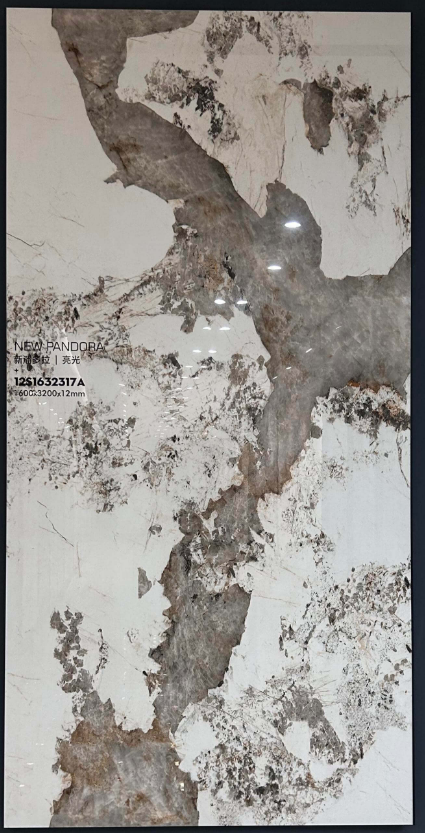
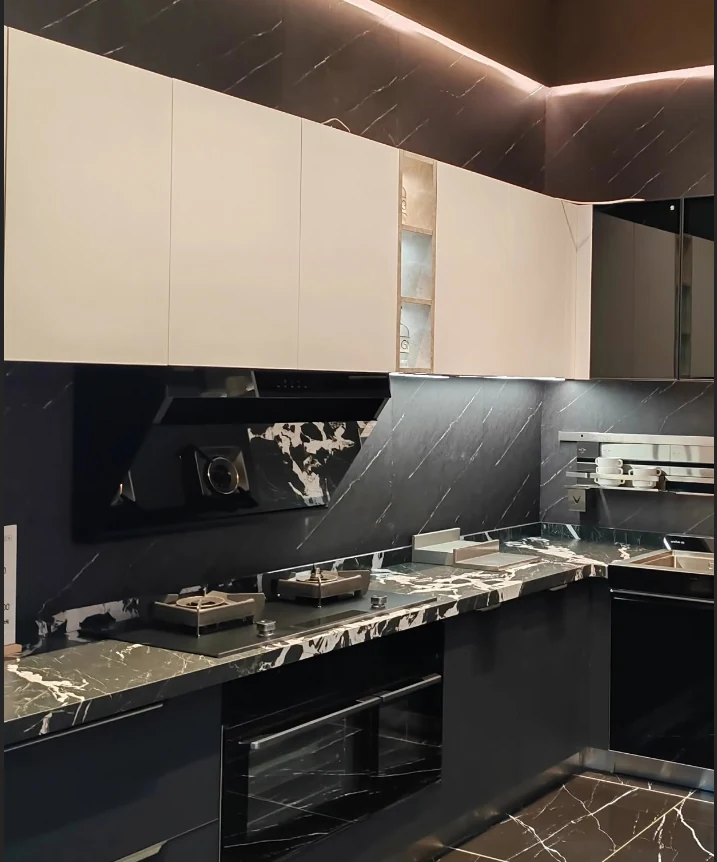
When a project requires more than standard slabs, cut-to-size sintered stone can simplify fabrication, installation and international sourcing.
Instead of importing full slabs and arranging all fabrication locally, buyers can provide finished dimensions or project drawings and have the material cut and processed before shipment.
This is especially useful for kitchen countertops, bathroom vanities, hotel projects, wall panels, furniture, tables and commercial interiors.
Quick Answer
Cut-to-size sintered stone means fabricating large-format slabs into the dimensions and shapes required for a specific project before delivery.
Depending on the project, fabrication may include straight cutting, edge polishing, mitered edges, laminated edges, sink or cooktop cut-outs, holes and pattern layout.
For the best result, buyers should provide the material, thickness, finished dimensions, quantity, edge requirements and drawings before production.
What Is Cut-to-Size Sintered Stone?
Standard sintered stone is normally supplied as large slabs.
For example, large-format slabs may be available in dimensions such as:
| Slab Size | Approximate Area |
|---|---|
| 3200 × 1600 mm | 5.12 m² |
| 2700 × 1800 mm | 4.86 m² |
| 1200 × 2700 mm | 3.24 m² |
| 1200 × 2400 mm | 2.88 m² |
For many projects, however, the buyer does not actually need complete slabs.
A kitchen contractor may need finished countertop pieces.
A hotel project may require hundreds of vanity tops.
A furniture manufacturer may need repeated table-top dimensions.
An interior contractor may need wall panels in several different sizes.
In these situations, the slabs can be planned, cut and fabricated according to the final project requirements.
This is what we mean by cut-to-size sintered stone.
What Can Be Fabricated?
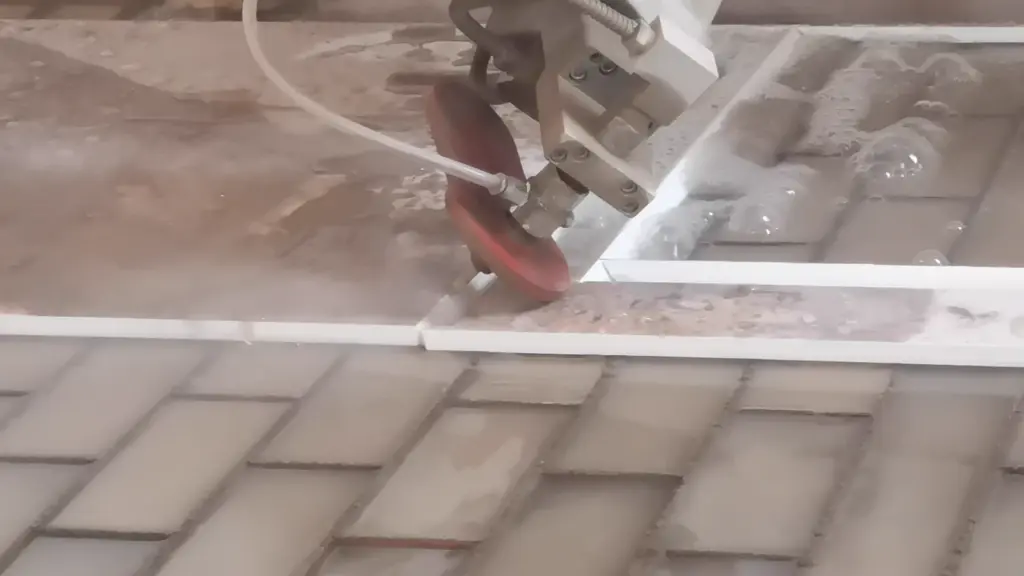
For project buyers, cut-to-size sintered stone can reduce the amount of fabrication required after delivery.
Depending on the material, thickness and drawing, cut-to-size fabrication can include:
- Straight cutting
- Custom dimensions
- Edge polishing
- 45-degree mitered edges
- Laminated or built-up edges
- Sink openings
- Cooktop openings
- Faucet holes
- Table tops
- Vanity tops
- Countertop pieces
- Wall panels
- Furniture components
- Pattern and vein layout
The exact processing method should always be confirmed before production because different designs and thicknesses can have different fabrication requirements.
Professional technical manuals for sintered and ultra-compact surfaces also emphasize correct cutting sequences, appropriate equipment and proper support during fabrication.
What Information Should Buyers Provide?
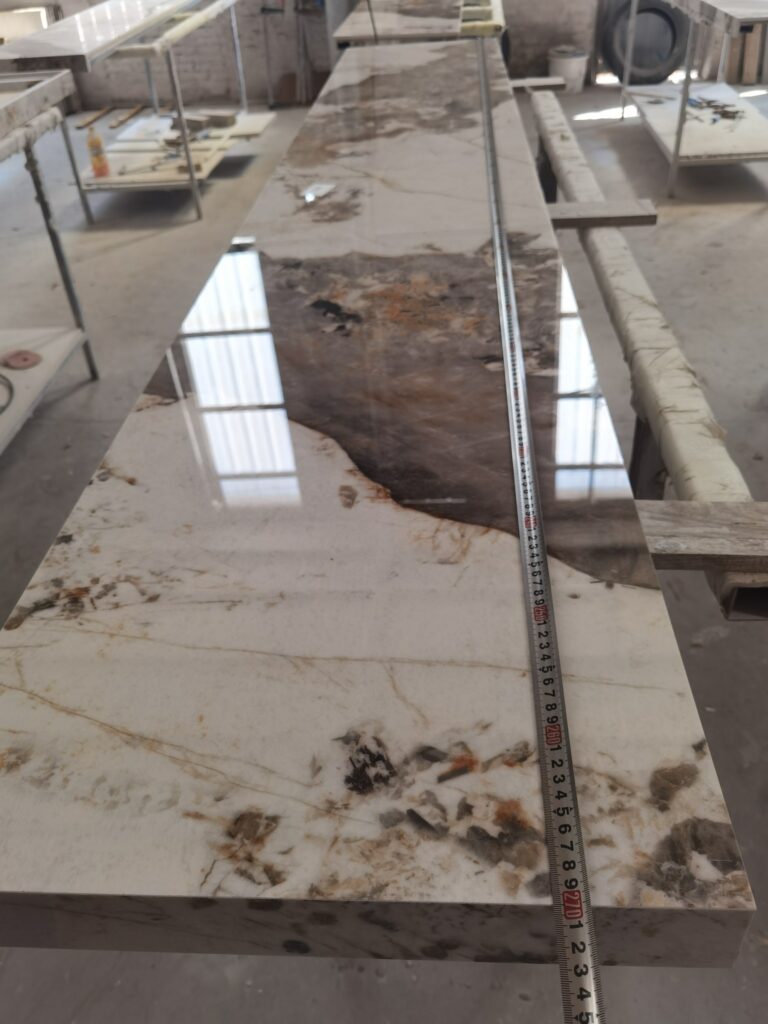
This is one of the most important parts of a cut-to-size project.
Before asking for a quotation, we recommend preparing the following information:
1. Material or Color
Send the selected design, product code or a reference image.
If you have not selected the exact material yet, a reference photo can help us recommend similar options.
For more help with material selection, see our How to Choose Sintered Stone Slabs guide.
2. Thickness
Specify the required slab thickness.
Depending on the collection and application, common project requirements may include 6 mm, 9 mm, 12 mm, 15 mm or 20 mm.
3. Finished Dimensions
Provide the final dimensions of every piece.
For example:
1510 × 505 × 12 mm
Quantity: 24 pieces
For projects with several sizes, a drawing or spreadsheet is usually more efficient.
4. Quantity
Please provide the quantity for each size.
This helps calculate:
- slab consumption
- cutting layout
- material waste
- fabrication requirements
- packing requirements
5. Edge Finish
Tell us which edges will remain visible.
Examples include:
- polished edge
- eased edge
- mitered edge
- laminated edge
If you are unsure, mark the visible sides directly on the drawing.
6. Cut-Outs and Holes
For countertop projects, clearly show:
- sink openings
- cooktop openings
- faucet holes
- socket openings
- other special cuts
Dimensions and positions should be confirmed before production.
7. Drawing
For complex projects, drawings are extremely important.
A clear fabrication drawing reduces misunderstandings and allows the production team to check dimensions and processing requirements before cutting begins.
8. Delivery Country
The destination also matters because finished pieces require appropriate export packing and transportation planning.
How Does the Cut-to-Size Process Work?
For project buyers, cut-to-size sintered stone can reduce the amount of fabrication required after delivery.
A typical cut-to-size project can be divided into several steps.
Step 1: Confirm Material and Application
First, confirm:
Material → Color → Thickness → Application
The same slab does not necessarily work equally well for every application.
A wall panel, table top and kitchen countertop may require different thicknesses and fabrication methods.
Step 2: Review Drawings
The fabrication team reviews:
- dimensions
- quantity
- edge details
- openings
- joints
- pattern direction
- installation requirements
If something is unclear, it should be confirmed before cutting.
This is particularly important for countertops with multiple openings or complicated shapes.
Step 3: Plan the Slab Layout
The finished pieces are arranged on the original slab.
The goal is not simply to fit as many pieces as possible.
The layout should also consider:
- vein direction
- visual consistency
- cutting sequence
- usable slab area
- waste
- fragile areas around openings
For vein-patterned sintered stone, this step can significantly affect the final appearance.
Step 4: Cutting
Large-format slabs are cut according to the approved layout.
Professional fabrication requires suitable equipment, proper slab support and an appropriate cutting sequence.
For some engineered surfaces, manufacturers specifically recommend separating the main finished pieces first and then processing holes and internal openings, rather than completing complex internal cuts before the piece is separated from the slab.
Step 5: Edge Fabrication
The next step depends on the design.
A simple project may only require a finished straight edge.
A premium kitchen island may use a 45-degree mitered edge to create the appearance of a much thicker countertop.
This allows designers to achieve a substantial visual effect without necessarily using an extremely thick solid slab.
Send us your drawing to discuss a cut-to-size sintered stone solution for your project.
What Is a 45-Degree Mitered Edge?
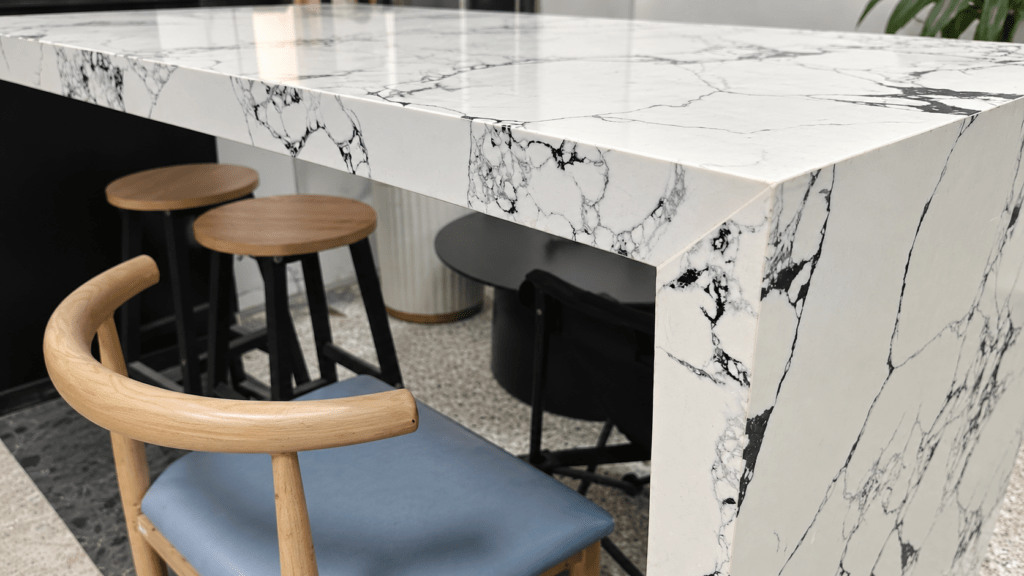
A 45-degree miter is one of the most popular fabrication methods for modern stone countertops.
Two edges are cut at approximately 45 degrees and joined together.
From the front, the countertop may appear significantly thicker.
For example, a relatively thin slab can be fabricated to create the visual effect of a thicker countertop edge.
This technique is often used for:
- kitchen islands
- waterfalls
- vanity tops
- reception counters
- luxury residential projects
- hotel interiors
The finished appearance depends on accurate cutting, pattern alignment and fabrication quality.
Can Sintered Stone Be Made with a Thicker Edge?
Yes.
Depending on the selected product and design, a built-up or laminated edge can be produced.
At Chameleon Stone, selected projects can use combinations such as:
- 12 + 8 mm
- 9 + 12 mm
- 12 + 18 mm
- 9 + 18 mm
The appropriate method should be confirmed according to the selected slab and final design.
This is especially useful when the designer wants a thicker visual profile without using a solid slab of the same apparent thickness.
Sink and Cooktop Cut-Outs
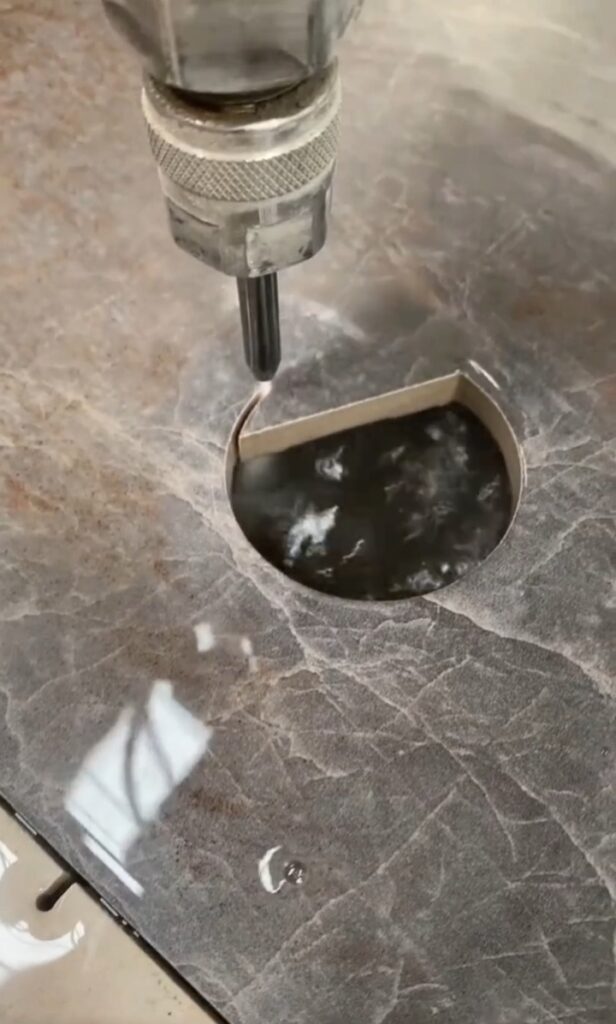
Kitchen countertops frequently require sink and cooktop openings.
These details should not be treated as an afterthought.
Before fabrication, the drawing should clearly show:
opening size + location + distance from the edge + corner design
Internal corners and openings can become stress-sensitive areas during fabrication, handling and installation.
For example, Dekton’s technical fabrication guidance specifically discusses internal corners, cutting sequence and minimum-radius treatment when fabricating pieces with corners.
For this reason, the exact drawing should be reviewed before production rather than cutting only from approximate measurements.
Vein Matching and Pattern Layout
This part is very important for marble-look sintered stone.
Imagine a buyer selects a dramatic Calacatta or Taj Mahal pattern.
If every piece is cut only according to dimensions without considering the original slab pattern, the final installation may look disconnected.
For decorative projects, the cutting layout should therefore consider:
- vein direction
- neighboring pieces
- bookmatch requirements
- waterfall edges
- island fronts
- visible joints
- repeated pieces
Can Every Finished Piece Have Exactly the Same Pattern?
For patterned materials, a well-planned cut-to-size sintered stone layout can help improve visual consistency across multiple finished pieces.
Not necessarily.
This depends on the original slab design and the required finished dimensions.
If a project requires multiple pieces with an identical or highly consistent pattern, the slab layout needs to be evaluated before production.
Sometimes a specific slab pattern can produce repeated pieces.
In other cases, only some pieces will have a similar pattern.
This should be confirmed before cutting rather than after production.
How Are Cut-to-Size Pieces Packed?
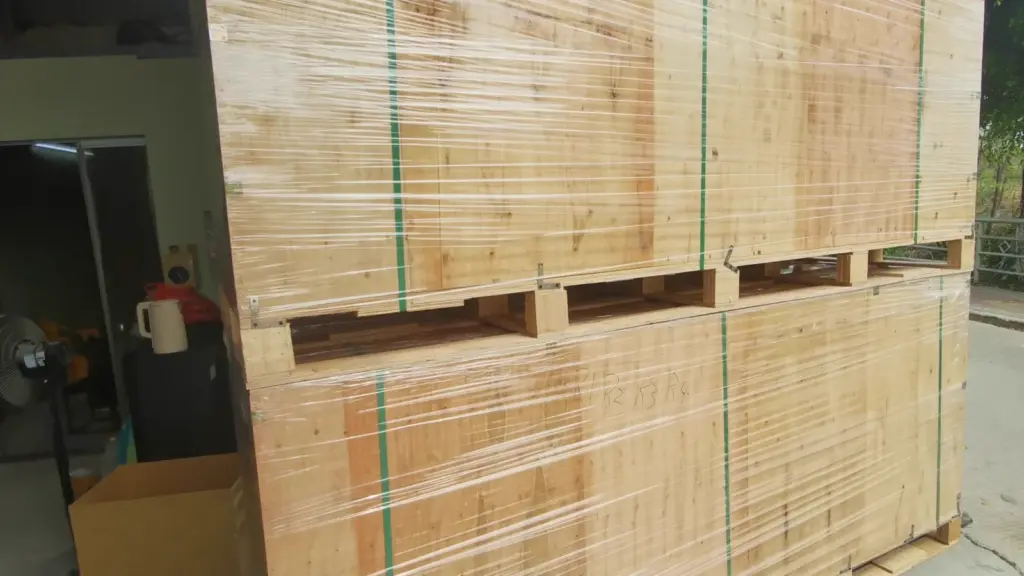
Finished pieces require different handling from full slabs.
Packing should consider:
- finished dimensions
- quantity
- fragile edges
- openings
- transportation method
- loading direction
Proper packaging and handling are also important for reducing damage during transportation.
Depending on the project, export packing may use reinforced wooden crates or frames.
Protection between pieces is also important to reduce movement and edge contact during transportation.
Major sintered-stone technical documentation treats packaging and slab handling as part of the fabrication workflow rather than a separate afterthought.
Full Slabs vs Cut-to-Size: Which Should You Buy?
There is no single answer for every buyer.
Cut-to-size sintered stone is especially useful when the project dimensions and fabrication details are already confirmed.
| Full Slabs | Cut-to-Size Pieces |
|---|---|
| Better for local fabricators | Better for defined projects |
| More flexibility after arrival | Less fabrication required locally |
| Local cutting required | Pieces arrive closer to final dimensions |
| Buyer manages slab optimization | Supplier can help plan slab layout |
| Suitable for stock distribution | Suitable for project orders |
Full slabs may be better if:
You are a slab distributor or have your own fabrication facility.
Cut-to-size may be better if:
You already know the final project dimensions and want more fabrication completed before shipment.
Common Mistakes in Cut-to-Size Projects
Mistake 1: Sending Only the Overall Size
An overall countertop length and width are usually not enough.
Edges, openings, joints and finished pieces should also be shown.
Mistake 2: Not Marking Visible Edges
The fabricator needs to know which edges require finishing.
Mistake 3: Ignoring Vein Direction
For marble-look surfaces, this can dramatically change the final appearance.
Mistake 4: Changing Dimensions After Cutting Starts
Dimensions should be finalized before production.
A major size change may require a new cutting layout and may also change material usage and project cost.
Mistake 5: Choosing Material Before Checking Fabrication Requirements
Some designs, thicknesses or edge treatments may have limitations.
Confirm the complete project requirements before final material approval.
Quick Cut-to-Size Checklist
Before sending an inquiry, prepare:
| Item | Information Needed |
|---|---|
| Material | Sintered stone / selected design |
| Color | Product code or reference |
| Thickness | e.g. 12 mm |
| Finished Size | Length × Width |
| Quantity | Pieces per size |
| Edge | Polished / mitered / other |
| Openings | Sink / cooktop / faucet |
| Pattern | Direction / matching requirement |
| Drawing | PDF / CAD / marked drawing |
| Destination | Country / port |
This information allows the supplier to evaluate the project much more accurately.
Frequently Asked Questions
Can sintered stone be cut to custom sizes?
Yes. Large-format sintered stone slabs can be fabricated into custom dimensions for countertops, wall panels, tables, vanities and other project applications.
Can you cut sink and cooktop openings before shipping?
Yes, depending on the project drawing and material. The size and position of each opening should be confirmed before fabrication.
Can you make a 45-degree mitered edge?
Yes. Mitered fabrication can be used to create thicker-looking countertop edges, islands and waterfall designs.
Can you fabricate directly from my drawing?
Yes. For project orders, drawings are strongly recommended because they show dimensions, cut-outs, edges and other fabrication details more accurately than text descriptions.
Can all pieces have the same vein pattern?
Not always. Pattern consistency depends on the original slab design, finished piece size and cutting layout. If matching is important, this requirement should be confirmed before production.
Should I order full slabs or cut-to-size pieces?
Full slabs are often suitable for distributors and local fabricators. Cut-to-size pieces are more suitable when final dimensions and project details have already been confirmed.
A well-planned cut-to-size sintered stone project starts with accurate drawings, confirmed dimensions and clear fabrication requirements.
Send Us Your Project Drawing
If you are sourcing sintered stone for a kitchen, hotel, commercial project, furniture collection or residential development, you can send us your:
material + color + thickness + dimensions + quantity + drawing
Our team can review the requirements and help evaluate slab usage, cutting layout, edge processing and packing before production.
Have a project drawing? Send it to Chameleon Stone and let us review the fabrication requirements with you.