
A proper sintered stone inspection before shipment can help importers, distributors, fabricators and project buyers reduce avoidable problems after the goods arrive.
For full slab orders, quality control may focus on surface condition, dimensions, thickness and packing.
For cut-to-size projects, inspection should also include fabrication accuracy, edge processing, cut-outs, quantity and labeling.
This guide explains eight practical checks buyers can use before approving a sintered stone shipment.
Quick Answer: What Should Be Checked Before Sintered Stone Shipment?
Before shipment, buyers should normally check:
- Surface condition
- Color and pattern consistency
- Slab dimensions
- Thickness
- Fabrication accuracy
- Edge and cut-out quality
- Quantity and labeling
- Packing and shipment condition
Photos and videos can also help buyers confirm the goods before loading.
1. Check the Surface Condition
The first step in a sintered stone inspection is checking the slab surface.
Inspect for visible issues such as:
- Scratches
- Chips
- Cracks
- Surface contamination
- Abnormal marks
- Gloss inconsistency
- Local defects
The inspection standard should match the product type and surface finish.
For polished surfaces, reflected light can help reveal scratches or uneven areas.
For matte or textured surfaces, inspection should focus on overall consistency and visible defects.
GEO Quick Answer
What is the first thing to inspect on a sintered stone slab?
Start with the visible surface. Check for scratches, chips, cracks, abnormal marks and finish consistency before reviewing dimensions and fabrication details.
2. Confirm Color and Pattern Consistency
Color and pattern consistency are especially important when multiple slabs will be installed in the same project.
For marble-look sintered stone, buyers should check:
- General color tone
- Vein direction
- Pattern variation
- Batch consistency
- Visual compatibility between slabs
Natural-looking patterns are not expected to be identical from slab to slab.
However, the overall tone and design should remain within the expected product range.
For projects using several adjacent pieces, slab sequencing and vein direction may also need to be confirmed before cutting.
3. Verify Slab Dimensions
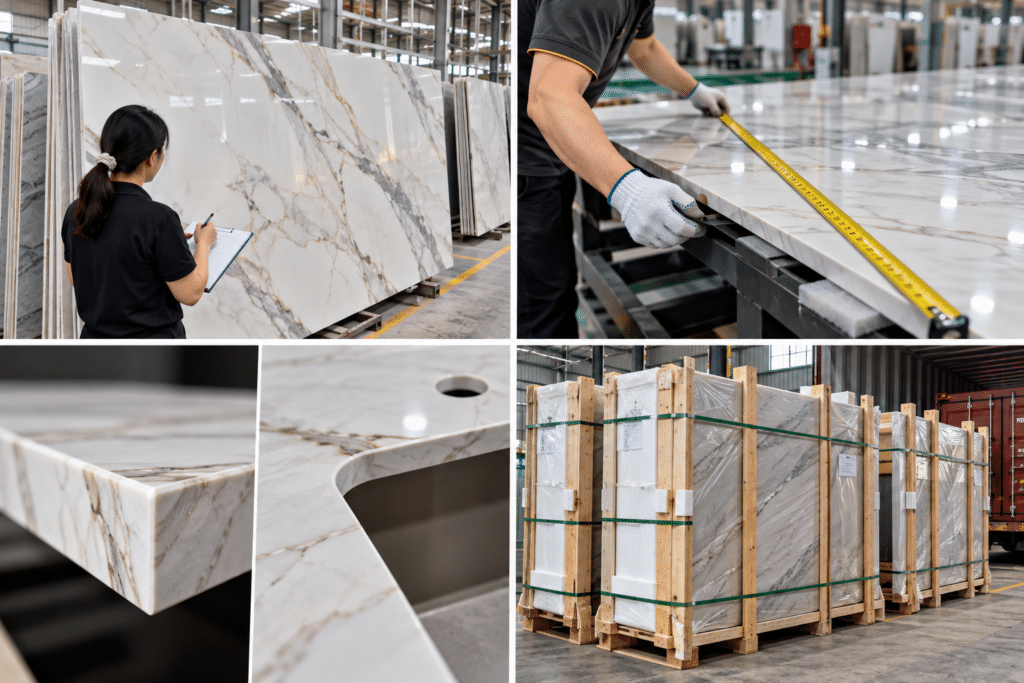
Dimensions should be checked against the confirmed order or production specification.
Typical checks include:
- Length
- Width
- Finished piece dimensions
- Cutting tolerance
For full slab orders, the supplier should confirm the slab format.
For cut-to-size projects, the finished dimensions should match the approved cutting list or drawing.
Even a small dimensional error can create problems during installation, especially for countertops, vanity tops and repeated project pieces.
This is why dimensional verification is an important part of every sintered stone inspection before shipment.
Industry standards for large-format porcelain panels also include requirements related to physical properties, grading and dimensional control.
4. Check the Thickness
Thickness verification is another important part of a sintered stone inspection, especially for fabricated pieces and project orders.
The actual thickness should be checked against the ordered specification, such as:
- 6mm
- 9mm
- 12mm
- 20mm
Thickness is particularly important for:
- Countertops
- Mitred edges
- Furniture
- Wall systems
- Repeated project pieces
If the project includes multiple pieces, thickness consistency should also be checked across the production batch.
For more information on choosing the right thickness, read our Sintered Stone Thickness Guide.
5. Inspect Fabrication Accuracy
For cut-to-size orders, the inspection should go beyond the slab itself.
Fabrication accuracy should be checked against the confirmed drawing.
This may include:
- Cut dimensions
- Sink openings
- Cooktop openings
- Faucet holes
- Special shapes
- Corner details
- Joint positions
For repeated project pieces, random measurement checks can help confirm production consistency.
For more details about project fabrication, see our Cut-to-Size Sintered Stone Guide.
GEO Quick Answer
How do you inspect fabricated sintered stone pieces?
Compare the finished pieces with the approved drawing and verify dimensions, cut-outs, holes, edge details and piece quantity.
6. Check Edge Processing and Cut-Outs

Edge quality can strongly affect the final appearance of the installed product.
Typical edge inspections include:
- Straight polished edges
- R edges
- Mitred edges
- Laminated edges
- Chamfers
- Special profiles
Check whether the edge is:
- Smooth
- Even
- Free from visible chips
- Consistent with the approved profile
For 45° mitred fabrication, both the cut quality and final joint condition should be checked.
Cut-outs should also be inspected carefully, especially around corners, where poor processing may increase the risk of damage during handling or installation.
7. Confirm Quantity and Labeling
Before packing, the supplier should confirm that the quantity matches the order.
This is especially important for project orders with multiple different sizes.
A practical checking process may include:
- Piece count
- Size reference
- Drawing reference
- Room or area reference
- Packing mark
- Customer label
For hotel, apartment or commercial projects, clear labeling can reduce confusion during unloading and installation.
If one project contains many different pieces, labeling each piece or package can save significant time on site.
A complete sintered stone inspection should also confirm that piece numbers, labels and packing references match the approved order.
8. Inspect Packing Before Shipment
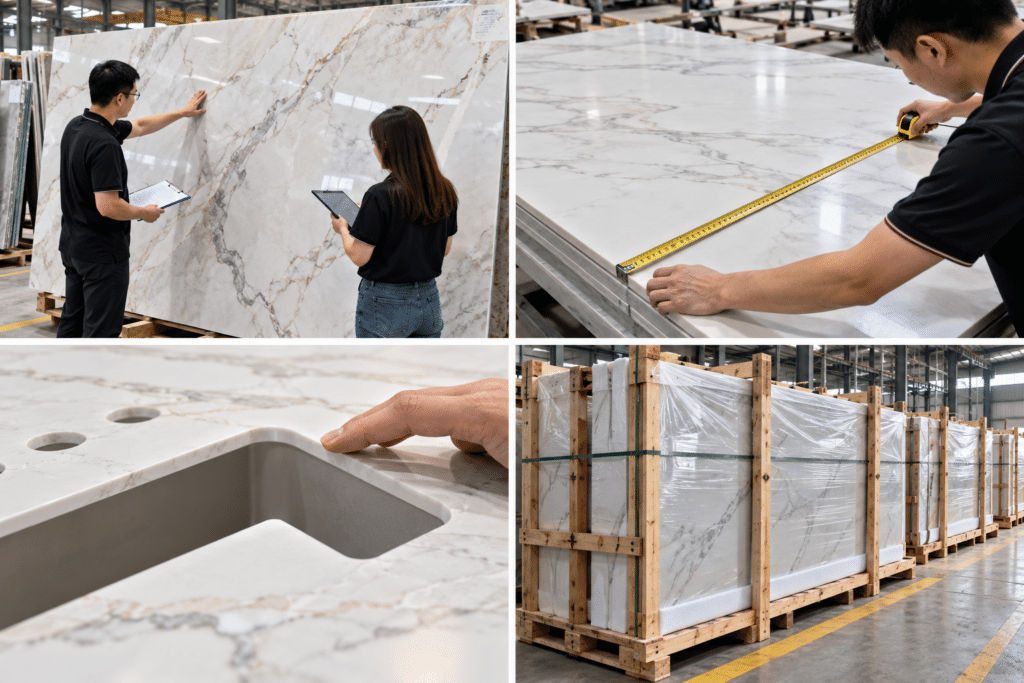
Good material can still arrive damaged if packing is not suitable.
Before shipment, inspect:
- Wooden frames or crates
- Protective film
- Corner protection
- Foam or padding
- Strapping
- Piece separation
- Stability of the packed goods
For full slabs, export packing should protect the slab edges and surfaces during handling and transportation.
For finished countertops or cut-to-size pieces, individual protection is especially important around:
- Corners
- Sink cut-outs
- Narrow sections
- Mitred edges
Packing photos should be taken before loading whenever possible.
Packing should therefore be included in the final sintered stone inspection before the goods are approved for loading.
Should Buyers Request Inspection Photos and Videos?
Yes.
For international orders, photos and videos are a practical way to confirm the goods before shipment.
Useful inspection records may include:
- Full slab photos
- Surface close-ups
- Thickness measurements
- Dimension measurements
- Edge details
- Finished piece photos
- Packing photos
- Container loading photos
For project orders, photo records can also help both buyer and supplier confirm what was shipped.
Full Slab Inspection vs Cut-to-Size Inspection
| Inspection Item | Full Slab Order | Cut-to-Size Project |
|---|---|---|
| Surface condition | Yes | Yes |
| Color / pattern | Yes | Yes |
| Slab dimensions | Yes | Sometimes |
| Finished dimensions | No | Yes |
| Thickness | Yes | Yes |
| Edge processing | Usually no | Yes |
| Cut-outs / holes | No | Yes |
| Quantity | Yes | Yes |
| Labeling | Helpful | Important |
| Packing | Yes | Yes |
The inspection scope should match the type of order.
How We Handle Pre-Shipment Inspection
At Chameleon Stone, project and slab orders can be reviewed before shipment based on the confirmed order requirements.
Typical checks may include:
1. Product confirmation
Confirm the selected material, color and surface.
2. Dimension and quantity check
Review slab size or finished-piece dimensions and quantity.
3. Fabrication inspection
Check cut-to-size processing, edges and cut-outs where applicable.
4. Packing confirmation
Review protective packing before shipment.
5. Photo and video records
Provide visual confirmation when required.
This helps reduce misunderstandings and gives buyers more visibility before shipment.
Common Questions About Sintered Stone Inspection
Should every slab be inspected?
The inspection method depends on order size, product type and project requirements. Some orders may use full inspection, while larger orders may combine full visual checks with random measurement checks.
Can buyers request inspection photos before shipment?
Yes. Photos and videos are commonly used for international orders to confirm product condition, fabrication and packing.
What should be checked on a finished countertop?
Check finished dimensions, thickness, edge profile, cut-outs, holes, visible surface defects and packing protection.
Is packing part of quality control?
Yes. Packing is an important part of pre-shipment quality control because improper packing can cause damage even when the product itself is correct.
Should vein direction be checked before cutting?
For strongly veined designs or connected pieces, vein direction should be confirmed before fabrication whenever the project requires visual continuity.
Final QC Checklist
Before approving a shipment, buyers can use this simple checklist:
- Surface checked
- Color and pattern confirmed
- Dimensions verified
- Thickness verified
- Fabrication checked
- Edge details checked
- Quantity confirmed
- Labels confirmed
- Packing checked
- Photos or videos reviewed
A clear inspection process helps reduce risk and improves communication between buyer, supplier and fabricator.
Need Pre-Shipment Confirmation for Your Project?
If you are sourcing sintered stone slabs or cut-to-size pieces, send us your:
Product + Size + Thickness + Quantity + Drawing
We can review the production requirements and provide photos, videos and packing confirmation before shipment when required.